This page is an a1 dutch grammar blog for NT2 students. If you are looking for dutch grammar for beginners and a clear nt2 grammar explanation of the dutch article "een", this guide is for you. We keep the language simple, so A1 learners can understand the dutch indefinite article rules step by step.
In this post we focus on one small but important part of dutch grammar: the word een. You will learn what dutch indefinite article means, when to use een, and how to make correct A1 sentences. At the end you will also find exercises and answers, so this text can be used as practice material in any nt2 basic grammar lesson.
1. What Is the Dutch Article “een”?
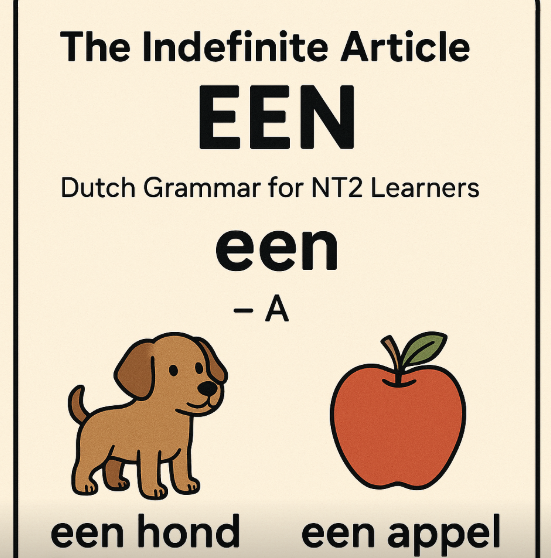
The word een is the dutch indefinite article. In English it is the same as a or an. We call it “indefinite” because it does not talk about a specific thing.
Examples (A1 dutch rules in simple sentences):
- Ik zie een hond. – I see a dog.
- Zij koopt een boek. – She buys a book.
In both sentences, we do not know which dog or which book. It is just any dog or any book. That is the main idea behind the dutch article een.
2. Important Dutch Indefinite Article Rules
For dutch grammar for beginners, it is useful to remember a small set of clear dutch indefinite article rules:
Rule 1 – Use “een” only with singular nouns
You can use the dutch indefinite article only with one thing, not with many.
- een stoel – a chair ✓
- stoelen – chairs (no article) ✓
- een stoelen ✗ (incorrect)
Rule 2 – No plural form of “een”
There is no plural form of een. In plural you usually use no article:
- Ik heb een pen. – I have a pen.
- Ik heb pennen. – I have pens. (no “een”)
Rule 3 – A1 Dutch Rules for Simple Sentences
NT2 students often learn this sentence order: Who – Verb – Place/Time – Rest. The dutch article "een" stands in the “rest” part, together with the noun.
- Ik - koop - in de winkel - een appel.
- Zij - heeft - op school - een tas .
These examples show how nt2 basic grammar rules can help you build correct sentences with the dutch indefinite article.
3. Difference Between “een” and “één”
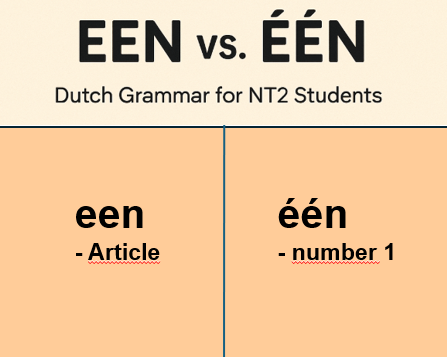
Many learners mix up een and één. This nt2 grammar explanation is very important:
- een = the article “a / an”
- één = the number “1”
Example:
Ik heb één pen en een boek.
→ I have one pen and a book.
In an a1 dutch grammar blog like this one, teachers often use colour or bold font to show the difference between the article and the number.
4. Visual Support – Images for NT2 Students
These simple visuals help a lot in dutch grammar for beginners.
5. Exercises – Practise the Dutch Indefinite Article “een”
Use these short tasks in class or at home. They match nt2 basic grammar level A1.
Exercise 1 – Fill in: “een” or nothing
Fill in the correct article.
- Ik koop ___ banaan.
- Zij ziet ___ vogels.
- Hij heeft ___ tas.
- Wij eten ___ broodjes.
- Jij leest ___ krant.
Answers
- een banaan
- vogels (no een)
- een tas
- broodjes (no een)
- een krant
Exercise 2 – Make a sentence with “een”
Use the structure: Who – Verb – Place/Time – Rest. This follows very simple a1 dutch rules.
Example:
Ik heb thuis een fiets.
- ___ eet ___ een appel.
- ___ heeft ___ een hond.
- ___ koopt ___ een tas.
Example Answers
- Zij eet op school een appel.
- Hij heeft thuis een hond.
- Ik koop in de winkel een tas.
With these exercises, this text is not only an a1 dutch grammar blog, but also a ready-made worksheet for dutch grammar for beginners.
6. Summary
- een is the dutch indefinite article (“a / an”).
- Use it only with singular nouns.
- There is no plural form of een.
- één with an accent is the number 1.
Save this page as your quick nt2 grammar explanation of the dutch article een. It covers core a1 dutch rules and is ideal for students and teachers who need clear, practical dutch grammar.
Continue Learning Dutch
If you enjoyed this explanation of the Dutch indefinite article “een”, you might also like these beginner-friendly NT2 lessons:
- Mastering Dutch Word Order (A1) – learn the basic sentence structure every NT2 student needs.
- When to Use “de” – a clear guide to the other Dutch articles.
- When to Use "het" - a clear guide tot the other Dutch articles.
- Essential NT2 Vocabulary for Daily Life – simple words and examples for A1 learners.
- Dutch Pronunciation Basics – improve your speaking confidence step-by-step.
Useful Tools for Learning Dutch
These trusted external resources can support your Dutch learning journey:
- DutchGrammar.com – extra clear explanations for beginners.
- WRTS – vocabulary trainer perfect for NT2 learners.
- Taalunie – official Dutch language information.
- Duolingo Dutch Course – great daily practice tool for A1 learners.